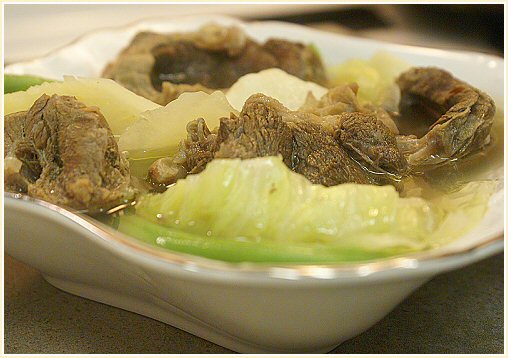
1 kilo of beef (round or sirloin cut) cut into cubes, beef tripe or oxtail (cut 2 inch long) or a combination of all three (beef, tripe and oxtail)
3 cups of peanut butter
1/4 cup grounded toasted rice
1/2 cup cooked bagoong alamang (anchovies)
2 pieces onions, diced
2 heads of garlic, minced
4 tablespoons atsuete oil
4 pieces eggplant, sliced 1 inch thick
1 bundle Pechay (Bok choy) cut into 2 pieces
1 bundle of sitaw (string beans) cut to 2" long
1 banana bud, cut similar to eggplant slices, blanch in boiling water
1/2 cup oil
8 cups of water
Salt to taste
Kare Kare Cooking Instructions:
In a stock pot, boil beef, tripe and oxtails in water for an hour or until cooked. Strain and keep the stock.
In a big pan or wok, heat oil and atsuete oil.
Sauté garlic, onions until golden brown, then add the stock, toasted rice, beef, oxtail and peanut butter. Bring to a boil and simmer for 15 minutes. Salt to taste.
Add the eggplant, string beans, pechay and banana bud. Cook the vegetables for a few minutes - Do not overcook the vegetables.
Serve with bagoong on the side and hot plain rice.
In a pot, boil pork in 2 cups of water with 1/2 teaspoon of salt until tender, then drain (keep the pork stock for later).
Mix 2 tablespoons of cornstarch and soy sauce then coat the pork with the cornstarch mixture.
Fry the pork in a skillet until golden brown, set aside.
Dissolve the remaining 2 tablespoons of cornstarch on 1/2 cup of pork stock - set aside.
Sauté garlic and onions on oil, then add the bell peppers, pineapple chunks (including the syrup), ketchup, sugar, 1/2 teaspoon salt and the dissolved cornstarch. Stir until sauce thickens.
Sinigang is a Philippine dish famous for the variety of ingredients. Sinigang often incorporates fish, pork, chicken, shrimp, or beef. This time we'll use Shrimp for our recipe. Sinigang's characteristic taste is attributed to the ingredient that gives its sour taste and most commonly use ingredient is Tamarind or Sampalok for its sour taste.
Ingredients: - 1 Kilo Shrimp - 1/4 kilo of Tamarind/Sampalok - 1 Onion, diced - 3 Tomatoes, quartered sliced - 2 pieces Radish regular size, sliced - 1 bundle of Sitaw - 1 bundle Kangkong, cut into 2" long - 3 pieces long green chilli - Salt or Patis to taste - Water
Cooking procedure: 1. Boil Tamarind in water to soften. Mash and extract all juices and set aside. 2. In a casserole, boil water and Tamarind juice, onions, tomatoes and Radish. 3. Lower fire then add in Shrimps, Kangkong, Sitaw and green long chilli. Simmer it for 5 minutes. 4. Season with salt or patis. 5. Serve it hot on a pot or palayok.
Chicken Adobo, Food Safari Chef Ricky Ocampo's Recipe. One of the recipes that intrigue me on the recent episode of SBS Australia TV’s Food Safari - Filipino Food Episode was the chicken adobo by Ricky Ocampo. On that episode Sydney cafe owner Ricky Ocampo shares his grandmother's recipe of chicken adobo.
I was fascinated by his cooking method of chicken adobo which involves frying the chicken first before adding the soy sauce, vinegar and other aromatic ingredients. Below is the segment where Chef Ricky Ocampo shares in details how to cook his grandmother's chicken adobo.
SBS Food Safari Chef Ricky Ocampo's Chiken Adobo
Now if you are interested in watching the full episode of the SBS Australia TV’s Food Safari Filipino Food episode click the link below.
Today I tried to replicate Chef Ricky Ocampo’s Food Safari’s chicken adobo. First of all I would strongly recommend using only the freshest chicken that you can buy. The aroma of the adobo cooking in our kitchen was very evident I tough even our neighbours would have smelled it. The chicken adobo was indeed taste good as claimed. The only negative comment is the final product was very oily because of the generous amount of oil during frying and the oil that rendered from the chicken skin and fats during frying. I would suggest reducing the amount of oil used in frying and if one is really a health buff use skinned chicken. Here is the recipe of my adaptation of Chicken Adobo, Food Safari Chef Ricky Ocampo's Recipe, go ahead have a try.
Ingredients:
1 kilo chicken, cut into large servings 1 cup apple cider or white balsamic vinegar 1/2 cup soy sauce 1/2 head garlic, peeled, crushed and chopped 2 tbsp. freshly coarsely ground black pepper 3-4 pcs. bay leaves 1/4 cup cooking oil
Cooking procedure:
In a large frying pan heat the cooking oil until it start to bubble.
Lightly fry the chicken for 10 to 15 minutes on all sides or until golden brown.
Add in the garlic and continue to fry for 2-3 minutes until the garlic are lightly browned.
Add the bay leaves, coarsely ground black pepper and soy sauce, continue to cook for 2 to 3 minutes. Now add in the vinegar, bring to a boil and reduce the heat to moderate to low.
Cover and let simmer for 25 to 30 minutes or until the liquid is reduce to an oily sauce. Serve with a lot of hot rice.
1 Pata (front or hind leg of a pig including the knuckles)
1 bottle of soda (7Up or sprite)
1 tablespoon of salt
2 tablespoons patis (fish sauce)
1/2 tablespoon baking soda
1 tablespoon of monosodium glutamate (MSG)
4 tablespoons of flour
Enough oil for deep frying
Enough water for boiling
Crispy Pata Cooking Instructions:
Clean the pork pata by removing all hairs and by scraping the skin with a knife. Wash thoroughly.
Make four to five inch cuts on the sides of the pata.
On a deep stock pot, place the pata in water with soda and salt. Bring to a boil and simmer for 20 minutes. Then add the baking soda and continue to simmer for another 10 minutes.
Remove the pata from the pot and hang and allow to drip dry for 24 hours. An alternative to this is to thoroughly drain the pork pata and refrigerate for a few hours.
After the above process, rub patis on the pata and sprinkle flour liberally.
In a deep frying pot, heat cooking oil and deep fry the pork pata until golden brown.
Crispy Pata Dip Sauce:
Mix 3/4 cup of vinegar, 1/4 cup soy sauce, 2 cloves of crushed garlic, 1 head of diced onion and 1 hot pepper. Salt and pepper to taste.
Sweet Potato Pie is a comfort food to most of the people I know (including myself). I’m not surprised why a lot of people love this dessert. It is nourishing; it tastes great; and it does not cost much. To top all that, did you know that making one is not that complicated? Have the ingredients ready and grab your baking tools, I’m about to show you how to pamper yourselves in the comfort of your own homes through this Sweet Potato Pie recipe.
Ingredients:
1 lb sweet potatoes
1 unbaked pie crust
1/2 cup butter, softened
3/4 cup granulated white sugar
1/2 cup evaporated milk
2 pieces raw eggs
1/2 teaspoon ground nutmeg
1/2 teaspoon ground cinnamon
1 teaspoon vanilla extract
Water for boiling sweet potatoes
Cooking procedure:
Heat a large cooking pot and pour-in water. Bring to a boil.
Put-in sweet potatoes then simmer for 45 minutes in medium heat.
Turn-off heat and remove the sweet potatoes. Let cool.
Run cold water on the potatoes while gently peeling the skins off. This can easily be done using your fingers.
Mash the sweet potatoes using a fork, a masher, or a pastry mixer.
Combine the mashed sweet potato and butter then mix well. You may use an electric mixer to make things easier.
Put-in milk, eggs, nutmeg, cinnamon, vanilla, and sugar then mix until the texture becomes smooth.
Preheat oven to 350 degrees Fahrenheit.
Arrange the mixture on the pie crust.
Bake for 45 to 55 minutes or until it passes the toothpick test.
In a casserole, sauté: garlic and onions in oil. Then add tomatoes, red & green pepper and chilli peppers.
Add in the beef, tomato sauce, liver spread and water or stock. Salt to taste and let simmer for at least 1 hour or until the beef is tender.
Add cheese and olives (optional) and continue to simmer until the sauce thickens.
Serve with plain rice
Cooking Tips:
Instead of beef, goat's meat (kambing) can be used. If goat's meat is used, marinate the meat in vinegar, garlic, salt and pepper for at least 15 minutes.
For a special kaldereta, do not use water or beef stock. Use an equivalent weight of onions to the beef (1 kg of onions : 1 kg of beef). The onions will serve as water to the dish.
1/4 kilo chicken liver and gizzard, sliced to small pieces
1/4 kilo cauliflower, broken to bite size
1/4 kilo string beans
1/4 kilo snow peas (sitsaro)
1/4 kilo cabbage, cut into squares
2 stalks of leeks, cut into 2" long pieces
3 stalks celery, cut into 2" long pieces
5 cloves garlic, diced
2 onions, diced
1 carrot, sliced thinly
1 piece red bell pepper, cut in strips
1 piece green bell pepper. cut in strips
2 tablespoons of cornstarch, dissolved in 1/4 cup of water
2 cups chicken stock (broth)
3 tablespoons of sesame oil
3 tablespoons of patis (fish sauce)
4 tablespoons of corn oil or vegetable oil
Salt to taste
Chopsuey Cooking Instructions:
In a big pan or wok, sauté garlic, onions then add in the pork. chicken liver and gizzard. Add 1 cup of stock, pinch of salt and simmer for 15 minutes or until pork and chicken giblets are cooked.
Mix in the shrimp then all the vegetables. Add the remaining 1 cup of stock, patis and the dissolved cornstarch. Cook for about 10 minutes or until the vegetables are done. Add the sesame oil.
1. Heat a large saucepan over high heat. Add a little oil. Brown the chicken fillets in batches and set aside. Add the chopped onion and cook for 2-3 min. Return the chicken to the pan.
2. Add the broccoli, curry sauce and coconut milk. Simmer for 10 min, or until chicken is cooked and broccoli tender. Season to taste with fresh lime juice or fish sauce. Serve with rice and garnish with sliced green/spring onions.
Boil sampalok in water until the shell shows cracks. Let cool then peal off the shells and with a strainer, pour samplalok (including water) into a bowl. Gently massage the sampalok meat off the seeds, strain again.
In a pot, sauté garlic and onion then add the tomatoes. Let simmer for 5 minutes.
Add pork and fish sauce then add the rice wash. Bring to a boil then simmer for 15 minutes then add the gabi. Continue to simmer for another 15 minutes or until the pork is tender.
Add the horse radish and simmer for 10 minutes then add the string beans, kangkong and sili (for spice-optional). Let boil for 2 minutes.
Serve piping hot.
Sinigang Cooking Tip:
Instead of sampalok fruit (tamarind), you can substitute it with any commercial souring seasoning like Knorr sampalok seasoning or tamarind bouillon cubes for this pork sinigang recipe.
1 kilo beef, cut into 1 1/2" x 1 1/2" cubes 8 potatoes cut the same size as the beef 1 bundle Pechay (Bok choy) cut into 2 pieces 1 small cabbage, quartered 5 onions, diced 1 head garlic, minced 4 tablespoons of patis (fish sauce) 3 tablespoons of cooking oil 10 corns of black pepper 1 liter of water Salt and pepper to taste
Beef Stew Cooking Instructions:
In a big casserole, heat oil and sauté the garlic and onions.
Add water, the beef, black pepper and patis. Bring to a boil then simmer for 1 hour or until the beef is tender.
Add the potatoes. Continue to simmer until potatoes are cooked.
Add the cabbage then the pechay. Do not over cook the vegetables.
Salt and pepper to taste.
Serve steaming hot in a bowl and plain white rice.
Cooking Tips:
You can substitute the beef with chicken (chicken stew) or pork (pork stew) for variety.
* 1 tblsp sesame seeds * 1/4 cup lemon juice * 2 tblsps soy sauce * 1/2 cup honey * 1.5kg chicken lovely legs, skin removed
Asian Vegetable Mix
* 1 x 125g packet baby corn * 2 red capsicums, thickly sliced * 1 bunch Chinese broccoli, coarsely chopped * 1 bunch baby bok choy, coarsely chopped * 1/4 cup oyster sauce
Method
1. Heat a medium pan. Add sesame seeds and cook, stirring, until golden. Stir in lemon juice, soy sauce and honey. Bring to boil then simmer until sauce reduces by half and thickens.
2. Place chicken in a large baking dish. Pour lemon sauce over chicken, turning chicken to coat evenly.
3. Cook in a hot oven (200C) for 25 minutes. Increase heat to very hot (240C) and cook for a further 15 minutes, or until golden brown and cooked through. Brush chicken occasionally with sauce during cooking.
4. To make Asian vegetable mix, add baby corn to a large pan of boiling salted water. Boil until corn is just tender. Add remaining vegetables to pan and boil until tender. Drain well. Transfer vegetables to a large bowl. Add oyster sauce and toss well to combine.
5. Serve chicken on Asian vegetable mix.
Notes
Chicken lovely legs are chicken drumsticks which have the skin and about 2cm of the bone removed above the first joint. You can substitute lovely legs with drumsticks or wings. If using wings, reduce cooking time by 10 minutes. Lovely legs are available at chicken shops or butchers.
The tamarind in this recipe is used extensively in Indian cooking and gives a delicious sour flavour. It's available in jars and cans as a paste, concentrate or pulp, from supermarkets and Asian grocery stores.
Here's how:
1 Combine the tamarind, sugar, chilli, ginger, garlic, chilli flakes and water in a jug.
2 Heat a wok or large heavy-based pan over a high heat until hot. Add 1 teaspoon of the oil and heat for another minute. Add a quarter of the prawns
3 Add the spring onion and beans to the wok or pan, and cook for 1 minute. Return the prawns to the pan. Add the tamarind mixture and cook for 1 minute, or until prawns are heated through and well combined with the sauce.
2 cups beef stock or 2 bouillon cubes dissolved in water
3 bay leaves (laurel leaves)
1/4 -cup vinegar
2 cups tomato sauce or 1/2 cup tomato paste
1 cup soy sauce
salt & pepper to taste
Beef Mechado Cooking Instructions:
Cut an incision on the beef chunks and insert a pork strip in the middle (mitsa)
In a casserole, combine the beef (with the fat), tomato sauce, soy sauce, bay leaves and beef stock. Bring to a boil and simmer until the beef is almost tender
Add the vinegar and let boil for a minute or two
Add the potatoes, onions, carrot, and bell pepper
Let simmer until potatoes and carrots are cooked - occasionally stir to thicken sauce
Serve hot with white rice
Beef Mechado Cooking Tips:
Pressure cook the beef with the beef stock for faster cooking time.
Fry the potatoes before adding to the casserole.
Add 2 to 3 tablespoons of olive oil and stir when the mechado dish is almost done for added flavor.